Have you ever noticed that Warrior I and High Lunge look very similar, yet feel quite different in your body?
Both yoga poses strengthen the legs, challenge balance and create an opportunity to work with hip extension. The main difference is the position of the back foot and that small change can significantly alter how the pose feels.
So, is Warrior I better than High Lunge?
Not necessarily. Neither pose is inherently better. The more useful question is:
Which variation feels appropriate for your body, your intention and your practice today?
Understanding the differences between Warrior I and High Lunge can help you practise with greater awareness and choose variations that support rather than strain your body.
What Is Warrior I?
Warrior I, traditionally known as Vīrabhadrāsana I, is a standing yoga posture named after Vīrabhadra, a warrior figure from Hindu mythology.
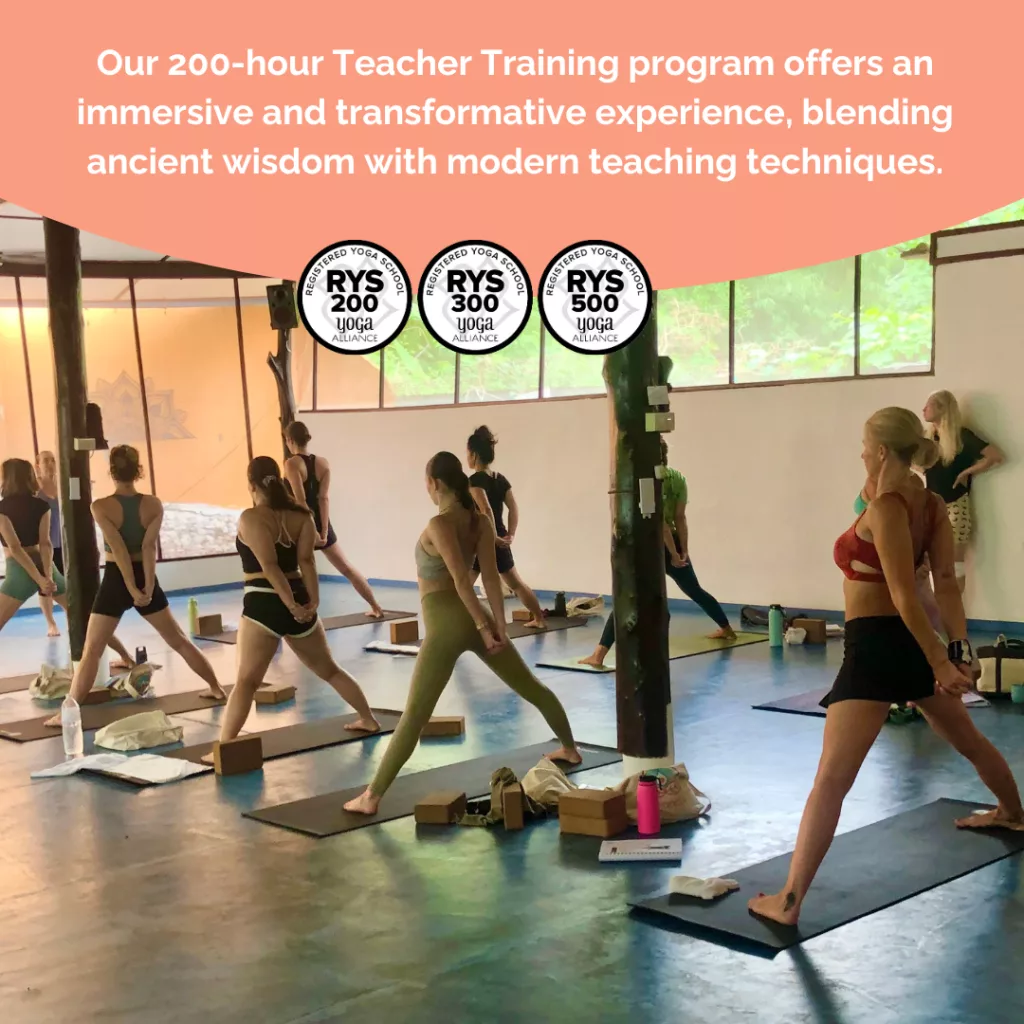
In Warrior I, the front knee bends while the back foot remains grounded. The back toes typically angle slightly outward, allowing the hips and torso to turn more towards the front of the mat.
The pose combines strength, stability and mobility. Depending on your alignment and range of movement, you may feel the posture through your legs, hips, shoulders and core.
Warrior I commonly includes:
- A bent front knee
- A grounded back foot
- A lifted chest
- Active legs
- Arms reaching upwards or another arm variation
- An element of hip extension in the back leg
The exact shape can vary depending on your body proportions, mobility and the style of yoga being taught.
What Is High Lunge?
High Lunge, sometimes referred to as Crescent Lunge or Anjaneyasana in some yoga traditions, is another standing pose that strengthens the legs and challenges balance.
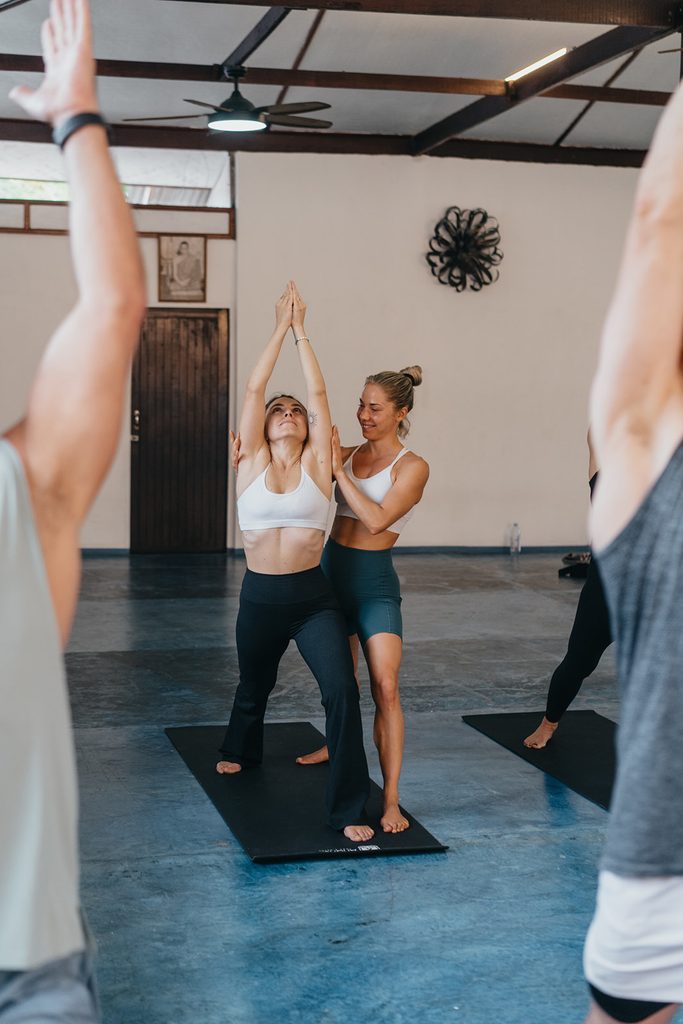
Unlike Warrior I, the back heel is lifted and the weight is distributed between the front foot and the ball of the back foot.
This creates a different sensation through the legs, hips and feet.
A typical High Lunge includes:
- A bent front knee
- The back heel lifted
- The back leg actively reaching backwards
- The torso upright
- Arms reaching overhead or positioned according to the variation
Because the back foot is not grounded, High Lunge can require greater balance and active engagement through the back leg and foot.
Warrior I vs. High Lunge: What Is the Difference?
At first glance, these two poses may appear almost identical. The position of the back foot, however, changes the experience considerably.
1. Back foot position
This is the most obvious difference.
In Warrior I, the back foot is grounded.
In High Lunge, the back heel is lifted and the practitioner balances more actively through the feet.
2. Balance
Because both feet are grounded in Warrior I, some people find it easier to establish stability.
High Lunge can feel more dynamic because the back heel is lifted. You may need to engage the legs and core more actively to maintain balance.
3. Hip position
Both poses can involve hip extension in the back leg, but the position of the feet changes how the pelvis can move.
Some people may find Warrior I encourages a stronger feeling of grounding, while High Lunge may allow a greater sense of forward movement.
Neither experience is automatically better. It depends on your anatomy, mobility and the intention behind the practice.
4. Leg strength
Both poses ask the legs to work.
The front leg supports much of the body’s weight while the back leg contributes to stability and strength.
High Lunge can create a particularly active sensation through the back leg because the heel is lifted.
5. Stability and grounding
If you are looking for a more grounded standing posture, Warrior I may feel more stable because the back foot is connected to the floor.
If you want to explore balance and active movement, High Lunge offers a different challenge.
Which Pose Should You Practise?
There is no universal answer.
Your choice can depend on what you want from your practice that day.
Choose Warrior I when you want to explore:
- Grounding and stability
- Standing strength
- A stable base
- Hip and chest opening
- A more anchored standing posture
Choose High Lunge when you want to explore:
- Balance
- Active leg engagement
- A lifted back heel
- Dynamic movement
- A strong standing sequence
You can also practise both. Many yoga sequences move between High Lunge and Warrior I, allowing you to experience the differences rather than treating them as competing poses.
What If Warrior I Feels Uncomfortable?
Yoga poses are not supposed to look identical on every body.
If Warrior I feels uncomfortable, consider experimenting with your stance rather than forcing yourself into a particular shape.
You might try:
- Widening your stance
- Reducing the depth of the front knee bend
- Adjusting the angle of the back foot
- Keeping the hands at the heart or on the hips
- Taking a shorter stance
- Using a wall for additional support
Small adjustments can make a significant difference.
What If High Lunge Feels Unstable?
High Lunge requires more balance because the back heel is lifted.
If you feel unsteady, you can make the pose more accessible by shortening your stance, reducing the depth of the front knee or practising near a wall.
You can also lower the back knee to the mat and explore a lower lunge variation.
The goal is not to stay in the most difficult version of a pose. The goal is to find a variation that allows you to practise with awareness.
Alignment Is Not One-Size-Fits-All
Yoga alignment is sometimes presented as though there is one perfect position for every practitioner.
In reality, bodies have different proportions, joint structures, mobility and movement histories.
For example, two people standing in Warrior I may have noticeably different foot positions or stances while both practising comfortably.
Instead of forcing your body to match a photograph, pay attention to how the pose feels.
Ask yourself:
Can I breathe comfortably?
Can I maintain stability?
Am I creating unnecessary strain?
Can I modify the pose and feel more supported?
These questions can be more useful than trying to achieve a particular visual shape.
Warrior I or High Lunge for Beginners?
Both poses can be introduced to beginners, although the appropriate variation will depend on the individual.
Warrior I may feel easier for some beginners because the back foot is grounded. Others may prefer High Lunge because it allows them to keep the back heel lifted.
A qualified yoga teacher can help you explore both options and find modifications that suit your body.
Remember that using a simpler variation is not a step backwards. It is simply another way of practising.
How Props Can Help
Yoga props can make standing poses more accessible.
A wall can provide support when balance is challenging. Blocks can also be useful in other standing or lunge variations when bringing the hands towards the floor.
Props are not a sign that you are doing yoga incorrectly. They are tools that can help you explore movement with greater comfort and awareness.
Listen to Your Body
Whether you choose Warrior I, High Lunge or another variation, the most important part of the practice is awareness.
A strong sensation does not necessarily mean a better pose, and going deeper is not always the goal.
If you experience sharp pain, unusual discomfort or instability, come out of the posture and choose a more comfortable variation.
Your practice can change from day to day. A pose that feels wonderful one morning may need to be modified on another day.
Finding Your Practice at a Yoga Retreat
At a yoga retreat, you have the opportunity to explore different approaches to movement rather than focusing on achieving perfect poses.
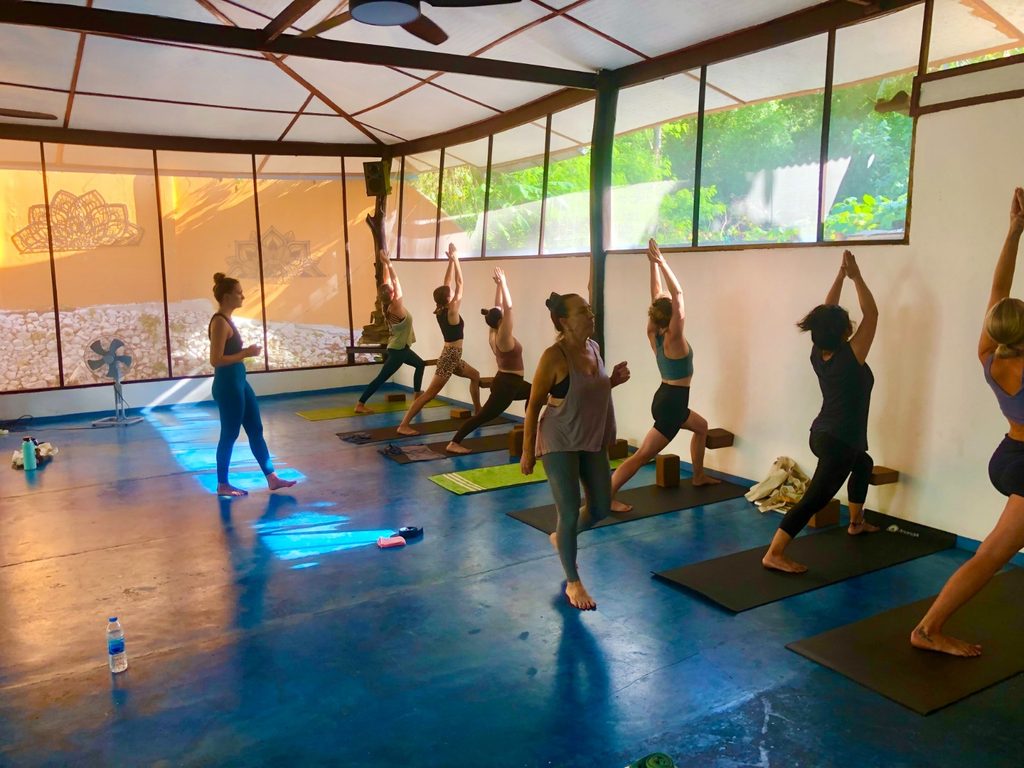
At our yoga retreat in Koh Phangan, Thailand, classes can provide opportunities to explore standing postures, mindful movement, breathwork, relaxation and different yoga traditions.
You do not need to arrive with perfect flexibility or extensive yoga experience. Your practice can be adapted to your experience level and how your body feels during your stay.
Final Thoughts: Warrior I vs. High Lunge
Warrior I and High Lunge may look similar, but they offer different experiences.
Warrior I provides a more grounded standing shape, while High Lunge introduces a lifted back heel and a different balance challenge.
Instead of asking which pose is better, consider asking:
Which pose supports what I need today?
Sometimes that might be Warrior I. Sometimes it might be High Lunge. And sometimes the best choice may be a completely different variation.
Yoga is not about forcing your body into a particular shape. It is about developing awareness, learning to listen and finding ways to practise that feel appropriate for you.