Every body is different, and yoga should reflect that. Two students can practise the same Yin Yoga posture yet experience completely different sensations, limitations, and benefits. Skeletal structure, joint mobility, body proportions, previous injuries, and individual experiences all influence how a posture feels.
Effective Yin Yoga teaching goes beyond demonstrating poses. Instead of expecting every student to achieve an identical shape, teachers must understand the intention behind each posture and adapt the practice to suit individual needs.
This philosophy is central to the 50-Hour Yin Yoga Teacher Training at Ananda Yoga & Detox Center in Thailand. The training explores functional anatomy, connective tissue, nervous-system awareness, and traditional Yin Yoga philosophy, helping participants develop a more thoughtful and adaptable approach to teaching and personal practice.
Understanding Functional Anatomy in Yin Yoga
Functional anatomy helps Yin Yoga teachers understand why different bodies respond differently to the same posture. Rather than focusing on external appearance, the emphasis is on how a position functions for each individual.
Skeletal Variation and Individual Differences
Human skeletons vary naturally. Differences in hip sockets, joint structures, spinal curves, and limb proportions influence how comfortably someone can enter a posture.
For example, one student might fold forward easily, while another experiences a natural limitation in the hips. Neither person is necessarily practising incorrectly. Their anatomical structures may simply differ.
Recognising these variations allows teachers to offer appropriate modifications using bolsters, blocks, blankets, or alternative positions.
Understanding Tension and Compression
Two important concepts in Yin Yoga are tension and compression. Tension generally describes stretching sensations in soft tissues, while compression involves contact or pressure between body structures, including bones and joint surfaces.
Understanding this distinction helps teachers recognise why pushing further does not always improve a posture. If a student’s range of motion is limited by skeletal structure, forcing a deeper position may create discomfort rather than additional mobility.
The goal is to help students explore appropriate sensations without chasing a particular shape or ignoring their body’s signals.
Fascia and Connective Tissue in Yin Yoga
Fascia is connective tissue that surrounds and connects structures throughout the body. It contributes to structural support and movement alongside tendons, ligaments, and other tissues.
Yin Yoga involves relatively passive postures held for longer periods, allowing practitioners to explore sustained loading and their body’s responses. However, the effects vary according to the individual, the tissues involved, and the intensity and duration of the posture.
Rather than promising that specific poses will release fascia or eliminate tension, responsible Yin Yoga teaching focuses on understanding sensations and practising within appropriate limits.
This knowledge helps teachers make informed decisions about posture variations, prop placement, and holding times while recognising that longer holds are not automatically better for everyone.
Yin Yoga and the Nervous System
Stillness can feel restorative for one person and uncomfortable for another. While some students enjoy long-held postures, others may experience restlessness or find remaining still challenging.
A supportive Yin Yoga practice recognises these differences rather than expecting everyone to relax in the same way.
Practical Tools for Nervous-System Awareness
Teachers can introduce simple practices to help students develop body awareness and explore relaxation at their own pace.
- Breath awareness: Invite students to observe their natural breathing without forcing changes.
- Gentle humming: Offer humming as an optional way to explore sound and vibration.
- Sensory awareness: Encourage students to notice contact with the mat, the support of props, and surrounding sounds.
- Interoception: Help practitioners recognise internal sensations such as warmth, pressure, and stretching.
- Choice-based teaching: Allow students to modify, shorten, or leave a posture whenever necessary.
The vagus nerve is frequently discussed in wellness settings, but nervous-system responses are complex. Breathing and sensory practices may influence aspects of autonomic activity, yet teachers should avoid promising specific physiological outcomes.
The aim is to create an environment that supports awareness, personal choice, and comfort.
Exploring the Five Elements in Yin Yoga
Yin Yoga is often associated with Traditional Chinese Medicine (TCM) and its Five Element framework: Water, Wood, Fire, Earth, and Metal.
These traditional concepts offer a framework for reflection and understanding patterns in nature and human experience. Water may represent adaptability, Wood can symbolise growth, Fire evokes warmth and energy, Earth suggests stability, and Metal can inspire reflection on boundaries and letting go.
An experiential approach allows students to explore these themes through observation, movement, and meditation rather than simply memorising theoretical associations.
At Ananda Yoga & Detox Center, the natural surroundings provide an opportunity to connect traditional Yin Yoga philosophy with personal reflection. This approach encourages students to explore how these concepts can inform sequencing, teaching, and their relationship with practice.
How to Adapt Yin Yoga Poses for Different Bodies
Adapting Yin Yoga poses is not about making the practice less effective. It is about finding appropriate ways for individuals to explore each posture’s intention.
Focus on intention, not appearance. Understand which area or movement pattern a posture is intended to explore before offering suitable alternatives.
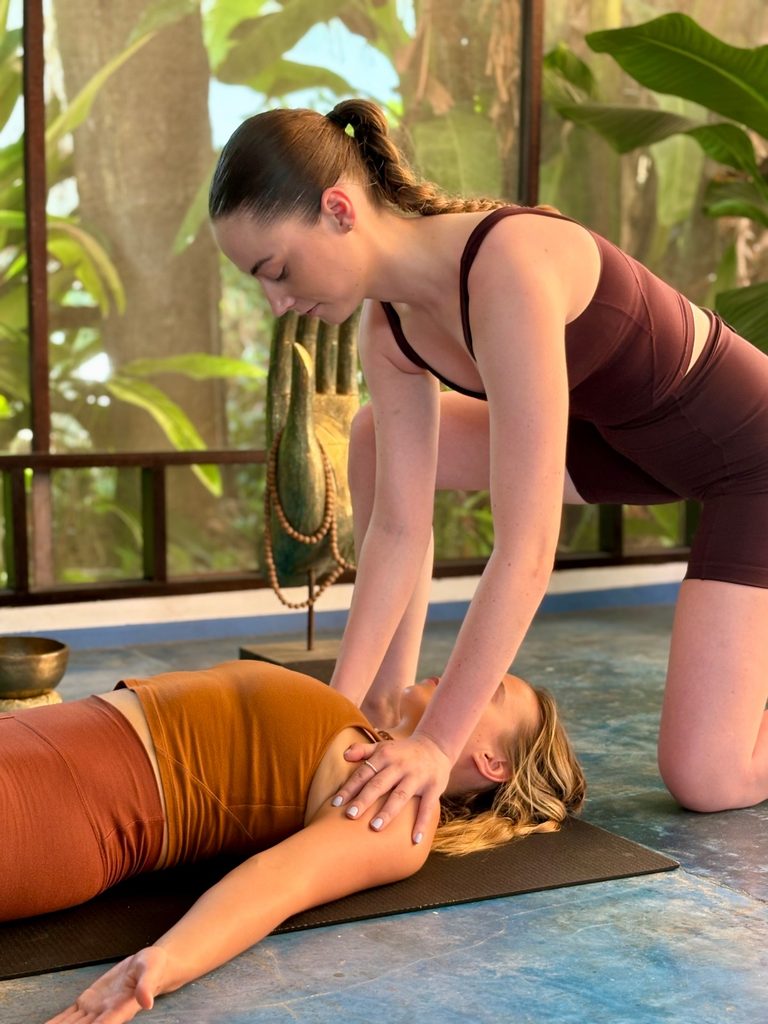
Use props intelligently. Bolsters, blocks, and blankets can support the body, improve comfort, and offer more options for different mobility levels.
Provide variations. A seated forward fold, for example, might be practised with bent knees, a supported torso, or an alternative seated position.
Encourage communication. Ask students about their sensations instead of assuming their experience based on how a posture looks.
Respect individual limits. Sharp pain, numbness, tingling, or increasing joint discomfort are reasons to modify or leave a position.
These principles help create a more inclusive practice where students can explore Yin Yoga without feeling pressured to match others.
Who Can Benefit from Yin Yoga Teacher Training?
A Yin Yoga teacher training programme can benefit both yoga instructors and dedicated personal practitioners.
For current or aspiring teachers, training provides opportunities to develop knowledge of functional anatomy, sequencing, cueing, posture modifications, and prop usage. These skills can support more responsive and individualised instruction.
Personal practitioners can also benefit without intending to teach professionally. Studying Yin Yoga more deeply can help them understand their movement patterns, recognise sensations, and develop a more mindful relationship with stillness.
Explore the 50-Hour Yin Yoga Teacher Training in Thailand
If you want to understand Yin Yoga beyond learning a collection of poses, Ananda Yoga & Detox Center offers a 50-Hour Yin Yoga Teacher Training in Thailand focused on deepening your knowledge and experience of the practice.
The programme explores functional anatomy, individual adaptations, nervous-system awareness, and traditional Yin Yoga concepts. It encourages participants to develop practical teaching skills while understanding how different bodies respond to postures.
Whether you are an experienced yoga instructor looking to expand your teaching or a practitioner interested in personal development, this training offers an opportunity to explore Yin Yoga through study, practice, and reflection.
Conclusion: Teach the Person, Not the Pose
Yin Yoga becomes more meaningful when we recognise that every body is different. Understanding skeletal variation, functional anatomy, connective tissue, and nervous-system responses allows teachers to move beyond rigid alignment expectations.
By offering modifications, using props effectively, and respecting individual boundaries, teachers can create a more supportive and adaptable practice.
Ultimately, Yin Yoga is not about achieving a perfect shape. It is about learning to observe, understand, and respond to the person practising. To develop these skills further, explore Ananda Yoga & Detox Center’s 50-Hour Yin Yoga Teacher Training in Thailand.