Hip opening is one of the most familiar ideas in yoga. But does having more flexible hips actually mean having healthier hips? Not necessarily.
Yoga can be an excellent way to maintain hip mobility, strength and body awareness. But for some people—particularly naturally hypermobile practitioners—the goal shouldn’t be to open the hips further. It may be to develop strength, stability and control within the range they already have.
What does “hip opening” actually mean?
When we talk about hip opening in yoga, we’re usually talking about increasing the range of movement around the hip joint: flexion, extension, rotation and abduction.
Healthy hip mobility can make everyday movements such as walking, squatting and getting up from the floor easier. It can also allow us to practise a wide variety of yoga postures comfortably.
But mobility isn’t the same as flexibility.
Flexibility describes how much range you can access. Mobility is your ability to control that range.
And that distinction matters.
Someone may be able to move into an impressively deep yoga posture but have very little strength or control at the end of that range.
Do your hips really need to be more open?
This is where the idea of “hip opening” deserves a rethink.
There isn’t one ideal amount of hip flexibility that every body should have. Hip anatomy varies considerably between individuals, including differences in the shape and orientation of the bones that make up the joint.
So two people may look completely different in the same yoga posture—and both may be moving appropriately for their bodies.
Trying to force the body into a particular shape can also encourage movement from other areas, such as the pelvis or lower back, rather than creating useful movement at the hip itself.
The goal of a yoga posture doesn’t have to be how far you can go.
It can be how well you can move and control the position you’re in.
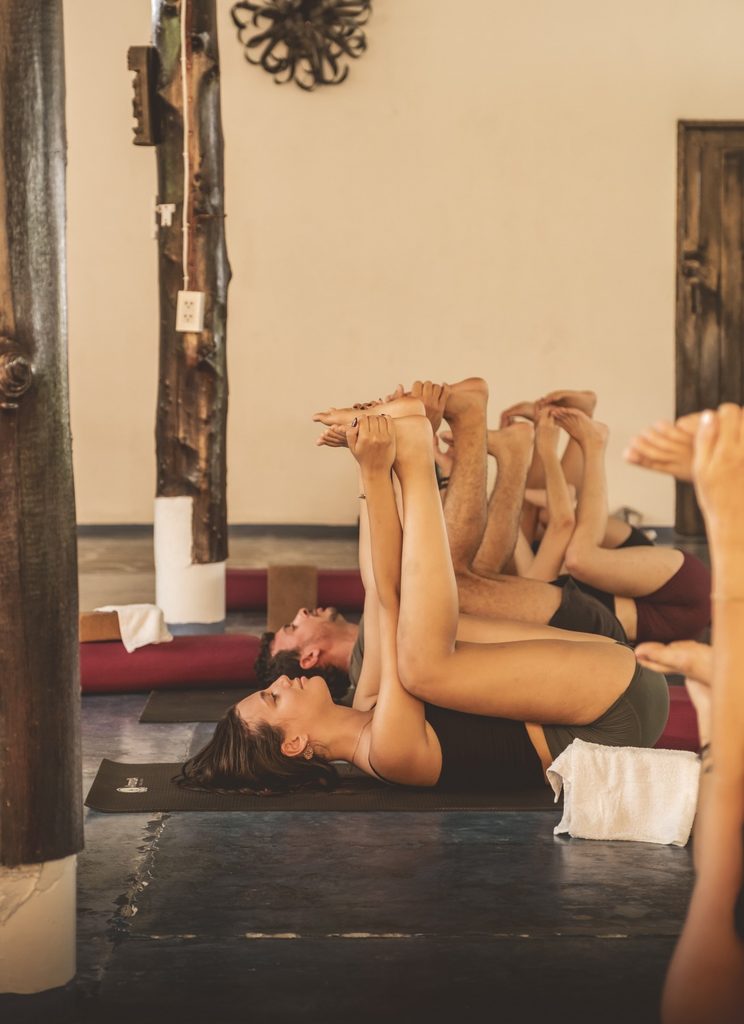
When hip flexibility becomes a problem
More flexibility isn’t automatically better.
For some people, repeatedly pushing into extreme ranges can create irritation, discomfort or a feeling of instability. Hip pain can also have many different causes, including conditions such as femoroacetabular impingement, hip dysplasia and labral problems.
This doesn’t mean that yoga causes hip injuries. It means that “stretch more” isn’t an appropriate solution for every hip problem.
Pain that is sharp, pinching, catching or persistent shouldn’t simply be interpreted as a sign that you’re successfully “opening” the hips.
If hip pain continues, it’s worth having it properly assessed rather than assuming you need more stretching.
What about hypermobile people?
This is particularly important for naturally flexible yoga practitioners.
Some people can move into very deep hip positions with little effort. They may find advanced yoga postures easy to access and may even receive positive feedback because their practice looks particularly flexible.
But a large range of movement isn’t necessarily the same as a strong or stable joint.
For someone who is hypermobile, continually chasing greater flexibility may not be the most useful approach. Strength and control can be more valuable than another few centimetres of range.
Instead of asking:
“Can I go further?”
try asking:
“Can I control this position?”
That change in focus can completely change the way a flexible person approaches yoga.
How can hyper-flexible people care for their hips?
A healthy practice for a hypermobile or very flexible person may include:
Build strength.
Strengthen the muscles around the hips and develop control through your available range.
Don’t always use your maximum range.
You don’t have to go to the deepest possible version of a posture simply because your body allows it.
Move slowly.
Controlled transitions help develop proprioception—the body’s awareness of where it is in space.
Pay attention to the quality of sensation.
A gentle stretch or muscular effort is different from sharp pain, pinching, catching or a feeling that a joint is unstable.
Balance mobility with stability.
A well-rounded yoga practice can include strengthening, balance, controlled movement and stability—not just stretching.
The controversy around “hip openers”
One of the more interesting conversations in modern yoga is whether the culture of continually pursuing greater flexibility has gone too far.
Yoga photographs and social media often reward spectacular ranges of motion. Deep pigeon pose, splits and other extreme positions can look like signs of an advanced practice.
But the visual shape of a yoga posture doesn’t tell us what is happening inside the joint.
Two people can look similar from the outside while experiencing very different forces and sensations internally.
This is also why teachers need to be careful about treating one version of a posture as the “correct” version.
There is no prize for having the most open hips.
Rethinking what “advanced” means
Perhaps one of the most useful things we can do is redefine what an advanced yoga practice looks like.
It isn’t necessarily the person who can put their leg behind their head.
It may be the person who has developed enough awareness to know when to go further—and when not to.
It may be the person who can access their range with strength and control.
And it may be the person who has stopped comparing their anatomy with somebody else’s.
Healthy hips aren’t necessarily the most flexible hips.
They are hips that can move, bear load, adapt and function well for the person they belong to.
So the next time you practise a hip opener, perhaps don’t ask:
“How much can I open?”
Ask instead:
“Can I move here comfortably, breathe here, and control the movement?”
That may be a much more useful definition of progress.