Kundalini Yoga is often called the yoga of intuition, inner power, and awakening. But beyond the mystique, it can be incredibly simple: breathe, move, and feel your own energy becoming clearer and more alive.
This guided practice (shared in the video below) is a journey through the spine, the breath, and the heart. It’s not about pushing or performing. It’s about gently unblocking what’s stuck, releasing what you no longer need, and reconnecting with the part of you that simply knows:
“I am enough. I am love. I am light.”

Here is the practice described step by step in words. For the full experience, nothing beats practising with a teacher — check out the video led by our Senior Kundalini teacher Raj.
1. Arrival: Breath, Sound & Centering
We begin seated, rolling the shoulders back and bringing the hands to the heart.
A few slow, shared breaths and the chanting of Om invite the mind to soften and the nervous system to settle.
This is the first doorway of Kundalini:
– Synchronising breath
– Vibration through sound
– Awareness turning inward
Already, the practice becomes less about “doing it right” and more about feeling present in your own body.
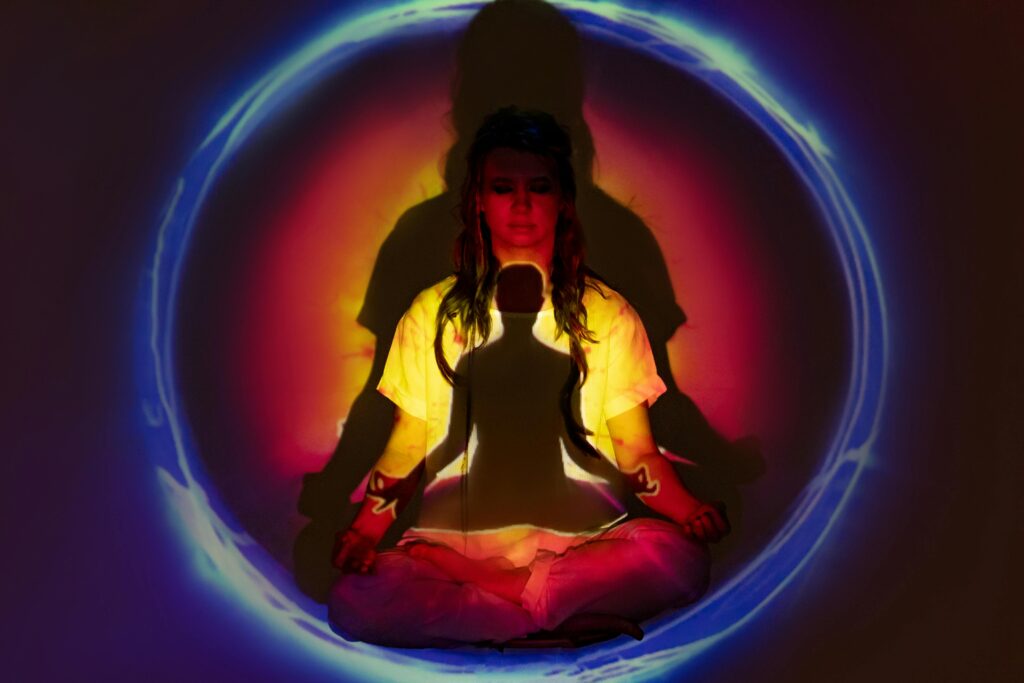
2. Awakening the Spine: Waves, Circles & Flow
From here, the practice moves into spinal circles, flexing, and gentle waves through the back body.
These movements: Lubricate the spine; Encourage energy to move up the central channel;
Help release stiffness, fatigue, and stuck emotion
The eyes are often softly closed, the tongue rests on the roof of the mouth, and attention drifts inward — classic Kundalini cues that guide the mind into stillness while the body moves.
3. Building the Inner Fire: Legs, Core & Dynamic Kriya
Once the spine is awake, we gradually build more heat and vitality.
This part of the practice weaves together:
- Standing shapes like chair pose and forward fold
- Seated twists led by breath
- Dynamic core movements from lying to seated and back again
- Kapalabhati breathing
- Full-body tapping to wake up the nervous system
Rather than thinking of it as exercise, it’s more like:
stoking an inner fire — the energy of willpower, clarity, and courage.
You may feel the heart beating stronger, the breath fuller, and a sense of aliveness moving through the body.
4. Opening the Heart & Softening Into Stillness
After the build comes the softening.
Gentle backbends and fish pose open the chest and abdomen, making space for deeper breath and emotional release. Then the body lowers into stillness.
Here, the teacher guides a meditation that speaks directly to the heart:
I am enough.
I am love.
I am light.
Kundalini becomes more than movement — it becomes a remembering of who you are underneath pressure, stories, and roles.
5. Integration: Returning to the Center & Sat Nam
To close, gentle stretches, twists, and rocking motions bring awareness back into the body. We return to seated, simply being with the breath and whatever is present — stillness, thoughts, emotion, or clarity.
The class ends by honouring Kundalini as a nurturing, intuitive energy within us, and sealing the practice with the mantra:
Sat Nam — Truth is my identity.
A reminder that beneath everything, there is something steady, real, and luminous in you.
Why This Matters
In a world that constantly pulls us outward, a grounded Kundalini sequence like this offers:
- A way to move energy without force
- A way to regulate the nervous system through breath and rhythm
- A way to reconnect with inner guidance and intuition
You don’t have to “awaken Kundalini” dramatically.
You can simply befriend your own energy, one breath, one practice at a time.
Deepening Your Journey: 50-Hour Kundalini Training
If something shifted in you during this practice — a spark, a softness, a curiosity — you may be ready to go deeper.
Our 50-hour Kundalini Training is designed for:
- Yoga teachers who want to integrate Kundalini into their classes
- Practitioners who feel drawn to energy, intuition, and consciousness
- Anyone wanting to understand not just what we do in Kundalini, but why it works
Ultimately, it’s a journey back to inner truth: Sat Nam — I am truth.